|
 Photo
Photo
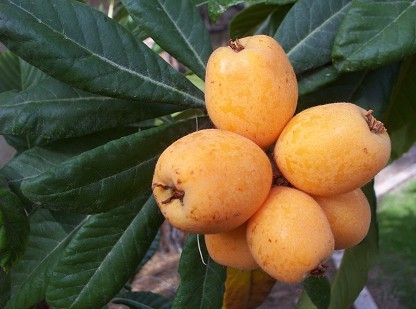
Pictured on the right is a cluster of ripe fruit in late March, produced from January flowers,
on a grafted Big Jim loquat tree.
This tree has been in the ground for 4 years and this is the first time
it has fruited.
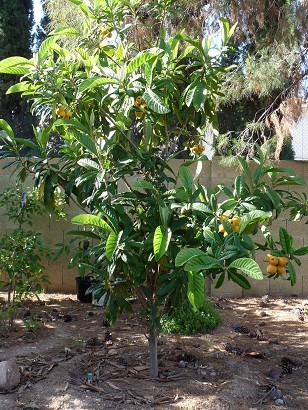
It is located on the east side of a large pine tree, very close to the larger trees dripline,
so it is in the shade in the afternoon.
The flavor of the fruit is peach like with a sprightly tang. It reminds me of
the flavor of the Mango Melon Starburst Fruit Chews.
This tree was planted in February and has more than doubled in size since then.
Overview
Loquats grow in the lower desert if they receive some protection from the afternoon
sun and adequate water. Their large exotic looking foliage is very attractive and
select varieties produce delicious fruit. Freezing is not a problem anywhere in the lower
and upper Sonoran desert. The most challenging aspect of growing loquats is their sensitivity
to salty soil, and specific nutrient deficiencies (detailed below).
 Fruit
Fruit
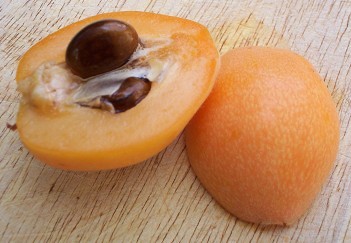
Loquats come in many varieties with fruit varying in size, color, and flavor. Big
Jim fruit, shown on the right, has one of the largest fruits and offers a very good
flesh to seed ratio. Loquat seeds
are large, black, and smooth and easily separated from the rest of the fruit. The
skin on the fruit is fuzzy like a peach but is not palatable. The easiest way to
eat a fresh loquat is to slice it open with a knife, discard the seeds, and then
eat the flesh off of the back of the skin, similar to how a kiwi is eaten.
Loquats grow easily from seed but
seedlings have a very low probability of producing good tasting fruit and might not
even fruit at all. Therefore, it is strongly recommended that only a grafted tree be purchased.
Grafts are sold as named varieties and the graft point should be clearly evident
near the base of the tree.
Heat Tolerance and Sun Exposure
Loquats need protection from afternoon sun in the lower desert. Exposure to direct sun
at temperatures over 100 degrees will scald the plants leaves and eventually kill it. Newly
planted trees should be protected from late morning sun their first summer using a shade structure.
After the first year, loquats do well in Eastern exposure and filtered sun.
Care should
be taken to choose a loquat variety that fruits during the mild months of the year so that
fruit is not lost to summer heat. Big Jim fruits are a good fit to the lower
desert because they are ripe in May.
Cold Tolerance
Loquats are evergreen, but freezing is not a problem in the Sonoran desert
because loquat foliage is hardy to 20 degrees Fahrenheit. Fruit and flowers
are less hardy so it is best to choose a variety of loquat that flowers after
the possibility of frost is past.
Planting
Dig a hole at least twice the size of the rootball. At a minimum, make the
hole 2 feet in diameter and 2 feet deep.
Back fill the whole with the same native soil that was removed.
It also is a good idea to finish with the
hole an inch or two recessed so that a watering basin is formed.
After planting, spread a thin layer of compost on top
of the soil to help conserve moisture and to supply some nutrients.
Do not fertilize the newly planted tree until it has been vigorously growing for
a couple of months.
Watering frequency
Loquats do well on a grass watering schedule. Newly
planted loquats need extra watering the first summer if their leaves get exceptionally
droopy.
Watering method
Basin or flood irrigation
is recommended because it helps keep the salt in our salty
water from accumulating around the roots. Furthermore, deep watering
will encourage the plant to develop deeper roots, making the plant tougher when the weather
gets hot and dry.
Fertilizing and Growth Rate
Loquats are very sensitive to soil salinity. Since Phoenix area water is already high
in salts, the safest thing to do is to not use any chemical nitrogen fertilizers.
Soil amendments such as compost are still beneficial, as are mild organic fertilizers
such as fish emulsion 0-10-10.
 Loquats exhibit some very specific nutrient deficiencies in the Phoenix area, which are often
mistaken as fireblight or salt burn. These deficiencies are most likely due to the soil alkalinity here.
The problem first shows itself by causing older leaves to dry up, starting at the edges and then falling off,
and it will progress over most of the tree.
Loquats will exhibit this behavior for years and it greatly slows their growth and can eventually
kill them. I lost my first loquat to this problem.
Loquats exhibit some very specific nutrient deficiencies in the Phoenix area, which are often
mistaken as fireblight or salt burn. These deficiencies are most likely due to the soil alkalinity here.
The problem first shows itself by causing older leaves to dry up, starting at the edges and then falling off,
and it will progress over most of the tree.
Loquats will exhibit this behavior for years and it greatly slows their growth and can eventually
kill them. I lost my first loquat to this problem.
To understand this problem, one must first realize that it
is not fireblight. Phoenix is just too dry for fireblight. The second thing to realize is that it is not salt
burn because salt burn distributes itself evenly over the tree, instead of going after older leaves first.
The pattern of the burning is suggestive of magnesium deficiency, and this appears to be what it is. I have
stopped this problem dead in its tracks and restored tree vigor by a single application of a three fingered pinch of
magnesium sulfate diluted in a gallon of water.
I pour this mixture on the ground around drip line of the tree
about once a month during the warm and hot months, but not during winter.
I have also had issues with my tree having burning on the new leaves which was not helped by adding manganese.
New growth was very slow and the emerging leaves quickly burned before they could reach a good size. The tree as a whole was also not
as dark green as normal. I believe this is a type of chlorosis, due to iron deficiency, or manganese deficiency.
It seems that loquats by nature will never really display yellow leaves. The leaves instead range from very dark green
to light green so chlorosis is harder to spot on this tree. I have found that
manganese sulfate
fixed this problem. I apply it the same way I apply magnesium sulfate by mixing it in a gallon of water and pouring it around the dripline.
Burning of older leaves can also suggest a potassium deficiency although the pattern is different than
what appears on the loquat. To be safe, I also give the tree a small dose of Alaska fish emulsion 0-10-10, also
diluted in water and poured around the drip line as per. the directions.
Some other organic source of potassium will probably also work well. The potassium treatment is most likely only
needed once or twice a year.
Other than the specific elements magnesium, manganese, and potassium a loquat does not seem to need much of anything else
in the Phoenix area. My tree grows steadily with no nitrogen supplement at all. Keep in mind, that loquats
are sensitive to salinity so adding any unecessary elements to the soil is risky.
Propagation
Loquats can be grown from seed, but good fruit will only be reliable on grafts.
Pests
Birds love loquats and can get all of the fruit unless measures are taken
to discourage them.
Attaching shiny foil colored helium children's balloons to the tree, when
the fruits start to turn color, is very effective.
Leave some cord attached to the balloon so it moves around unpredictably.
These type of balloons are also thick skinned so they won't pop easily like
standard rubber balloons. Covering the tree with a net also works but will
break the branches on young trees, so this is only recommended for larger trees.
Loquats are also susceptible to fire blight, a disease that affects roses, but
this doesn't appear to be a problem in Arizona's dry climate.
Life Span
Unfortunately grafted loquats seem to be short lived trees with a life span of about 15 to 20 years. I am
not sure how long a seedling is expected live.
More Photos of Loquats Growing In the Phoenix Area
Here is an additional page showing loquats growing in the lower desert. If you
would like to contribute a picture to this site, please feel free to e-mail your
digital photo, along with an explanation of where you live, your loquat variety,
and anything else you would like to add.
More Loquat Photos
Links to more loquat information
Julia Morton
California Rare Fruit Growers
|
 Join The Phoenix Tropicals Gardening Forum On Facebook
 Book the Phoenix Tropicals Condo on Kiahuna Beach, in Kauai, Hawaii