|
Unfortunatley, this avocado died about 5 years after being planted. I attribute its demise to its proximity to a large pinetree. While the
pine tree provided shade it also competed with the avocado for nutrients and water. After 3 years of very healthy growth, the avocado tree's growth
first slowed considerably and then it started to look pale. I had great success with some of my other plants giving them magnesium sulfate so
I tried an application with this tree and it burned it terribly. After that the tree slowly perished over 2 years. It would die back periodically then try to
recover but not to its former size before dying back again. Slowly it became nothing but a stump and then grew no more.
Without a doubt the Winter Mexican variety did better here than any other I have tried. The next best variety is a Mexicola from Home Depot which surely
came from California. I still have this Mexicola in the shade and it never really grows but has been a small half dead shrub for years. Regardless, it has
been alive for 7 years and I don't even pay attention to it!
Advocado's are extremely challenging to grow here. There are a couple of big trees around the Phoenix area, and I have seen them. However, I have never
tasted a good tasting fruit from one. I have tasted some bad tasting fruits from some friends' trees, but never a good one. The bad tasting ones
tasted like they were fermented which I think is what you can expect if a fruit ripens here when it's really hot out. I think you definitely want a Winter
ripening variety here. One of the most remarkable trees in Arizona
is one on a ranch in Aravaipa Canyon. It appears to have been a lucky seedling. Aravaipa Canyon is
10 F. degrees cooler then Phoenix, because it is higher altitude, so it is not exactly the same climate as here. I have not had the fruit from this one either.
Here is a link to a video about a tree growing in Mesa Arizona
Mesa Arizona Avocado.
I'm fairly tempted to try a Winter Mexican in a better spot in my yard again one day. Funny thing is that I'm not a big avocado lover, but my wife is, ha ha.
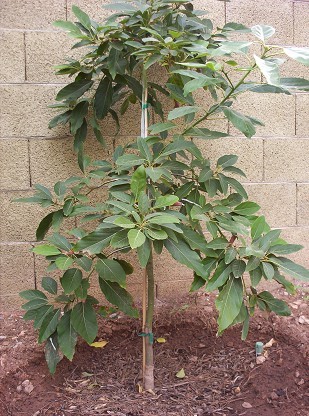 Photo
Photo
The avocado tree on the right was photographed in March of 2009, which is
about 1.5 years after it was planted in October of 2007.
It is planted on the north side of a wall and the east side of a
large pine tree. The pine tree almost overhangs the avocado, so it gets morning sun and
afternoon shade.
This avocado tree is a variety named Winter Mexican, a Mexican x West Indian hybrid,
and was mail ordered from Florida.
It is doing really well so far and has almost doubled in size to 6 feet tall. It has flowered once but
has not set any fruit.
This plant has also tolerated 115 F. in the middle of summer without
problems, and there should be no worries of this variety being damaged in the winter
because it is reportedly hardy to 22 F. This avocado tree shows no signs of salt burn which is quite
amazing considering my experience with other avocado trees.
Previously, I attempted to grow two avocados trees from California
and they both died.
All the avocado trees available in local stores are from California.
My first attempt, a Haas avocado tree, was planted in early spring and died in themiddle of
summer, even though it was in full shade. The Haas shriveledup like a piece of lettuce in the sun
when temperatures went over 115 degrees Fahrenheit. It just couldn't take the heat.
My second California avocado attempt was a variety called Zutano. It took the heat better than
the Haas and faired well in the winter even when temperatures went down to 26 F., which is very
unusual weather for the Phoenix metro area. However, the Zutano slowly racked up salt burn damage which eventually
finished it off. It lasted about 2.5 years, and didn't grow much if at all.
Florida avocado trees might do better here in Arizona than the California grown plants because
they are grown on more salt resistent rootstock such as Lula and Waldin, where as the
California variety rootstocks are more resistant to root rot, but salt sensitive.
Overview
Avocado trees seem to be the gardening urban legend of
Phoenix. Supposedly there are large mature avocados somewhere in the Phoenix area, producing
bushels of wonderful fruit, and when the moon is full there are fairies and leprechauns playing in the
branches. Okay, I made that last part up, but I have yet to see a large avocado tree
growing and producing in the ground here. The above picture does show that there is hope
but the jury is still out as to whether this tree will at some point
produce delicious fruit.
The main problems with growing avocados in Phoenix is that they don't like the summer heat
or the salty soil and water. Winter cold does not seem to be a problem with the more hardy
varieties.
Heat Tolerance and Sun Exposure
Young avocado trees definitely need afternoon shade in the lower Sonoran Desert
and should be shielded from the sun with shade cloth in June, July, and August.
Being on the east side of a deciduous tree is an ideal spot because the tree
will get the protection it needs in the summer, but will get full sun in the winter.
As for heat tolerance by variety, I have found that Haas avocado trees cannot
take the summer heat here no matter how much shade they get while other varieties
fare better.
Cold Tolerance
The more cold tolerant Mexican avocado varieties are able to take temperatures
as low as citrus trees can. So, there is not much reason to be concerned about them
in developed areas of town. My Zutano tree survived temperatures as low as 26 F. without
a single damaged leaf, while many of the ficus trees in the neighborhood were killed.
I have not seen no evidence of frost damage on my Winter Mexican avocado tree and it
has been in the ground two full winters with no protection.
Planting
Dig a hole at least twice the size of the rootball. At a minimum, make the
hole 2 feet in diameter and 2 feet deep.
Back fill the whole with the same native soil that was removed.
It also is a good idea to finish with the
hole an inch or two recessed so that a watering basin is formed.
After planting, spread a thin layer of compost on top
of the soil to help conserve moisture and to supply some nutrients.
Watering method
The biggest challenge for growing an avocado tree here is the salinity
of the soil and water.
Basin irrigation is the most effective watering method for pushing salt away from the trees root ball.
Watering frequency
Avocado trees do well on a grass watering schedule.
An occasional deep soak is beneficial if the trees leaves are showing signs of salt burn.
Deep soaking is done by turning the hose on very low and letting it run at the base of
the tree for several hours. Deep soaking will help to wash salt to the edges of the area of
soaked soil. After deep soaking, one can often see a visible ring of salt.
Fertilizing and Growth Rate
Avocados are very salt sensitive, so it is safest not to use any chemical or organic fertilizers on them. Maintaining
a light layer of compost around the trees base is the safest
way to supply it with extra nutrients.
Pests
Avocados have no significant pest problems in Arizona.
Links to more avocado information
Growing avocados at TAMU
Growing avocados at CRFG
Avocados at Wikipedia
|
 Join The Phoenix Tropicals Gardening Forum On Facebook
 Book the Phoenix Tropicals Condo on Kiahuna Beach, in Kauai, Hawaii