|
This plant died in September 2011, about 4 years after being planted. It died back more than it advanced over the years.
After digging it up I saw the roots never really made it past the diameter of the original pot, but they were not rootbound
so it leads me to believe the soil was the biggest challenge for this tree. At the moment, I have to conclude that
Cherry of the Rio Grande is not a very good fit for Arizona. The information below is probably still valid as a best
cultural practice for this plant in our soil. If I would change anything about how I took care of it, I would say that
one should not fertilize it at all.
If anyone is having real success with growing a CRG in the ground here I would like to hear from you. :)
 Photo
Photo
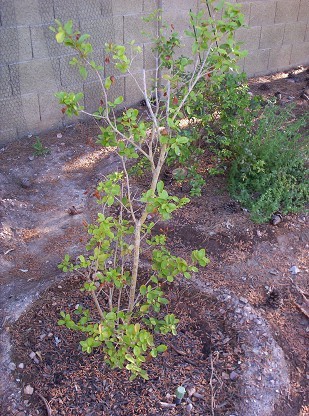
Shown on the right is a 4 foot cherry of the rio grande tree in April.
It is located on the north side of a 6 foot block wall and on the east side
of a large pine tree, so it receives afternoon shade.
This plant was mail ordered from Florida and planted in full sun its
first year. It did flower the first spring but did not set fruit.
In June of its first year, the Arizona sun proved to be too much for
it and it started to sunburn substantially, so it was transplanted into
its current location. It did not flower its second spring and still
appeared to be recovering from last summer. In its current location
it also sun burned but not as badly as before. This summer, its second, it is currently
under shade cloth and I hope it will better be able to handle the summer
heat when better established and more fully protected by its own leaves.
This cherry of the rio grande was subjected to temperatures of 26 F.
in the winter of 2007 and sustained no significant damage.
Overview
Cherry of the rio grande (eugenia involucrata) can be grown in Phoenix but has difficulty with the summer
heat, sun, and alkaline soil. It appears to also be sensitive to soil salts, and therefore should
not be fertilized. It is evergreen and handles the coldest weather that the Phoenix
winter can produce without problems. It grows continuously but slowly during warm weather. The most
attractive thing about cherry of the rio grande is that its fruit tastes very much like
real cherries.
Heat Tolerance and Sun Exposure
Cherry of the rio grande trees need afternoon shade. During their first couple of years they might
even need to be protected with a shade cloth until they are established.
Cold Tolerance
Being hardy to 20 F.,
cherry of the rio grande trees can take the coldest Phoenix weather without protection.
Planting
Dig a hole at least twice the size of the rootball. At a minimum, make the
hole 2 feet in diameter and 2 feet deep.
Back fill the whole with the same native soil that was removed
mixed with several pounds of sand.
Be sure to mix the backfill as thoroughly as possible.
It also is a good idea to finish with the
hole an inch or two recessed so that a watering basin is formed.
After planting, spread a thin layer of compost on top
of the soil to help conserve moisture and to supply some nutrients.
Watering frequency
Cherry of the rio grandes do well on a grass watering schedule during summer,
and a citrus watering schedule during winter.
Watering method
Basin irrigation
is recommended because it helps keep the salt in our salty
water from accumulating around the roots. Furthermore, deep watering
will encourage the plant to develop deeper roots, making the plant tougher when the weather
gets hot and dry.
Fertilizing and Growth Rate
Cherry of the rio grandes appear to burn very easily in Phoenix soil
so any kind of fertilizer should be avoided.
A thin layer of compost around the tree's base is also beneficial.
Propagation
Cherry of the rio grandes are grown from seed.
Pests
No known pests in Phoenix Arizona.
Links to more cherry of the rio grande information
Cherry Of The Rio Grande - Wikipedia
|
 Join The Phoenix Tropicals Gardening Forum On Facebook
 Book the Phoenix Tropicals Condo on Kiahuna Beach, in Kauai, Hawaii