|
 Photo
Photo
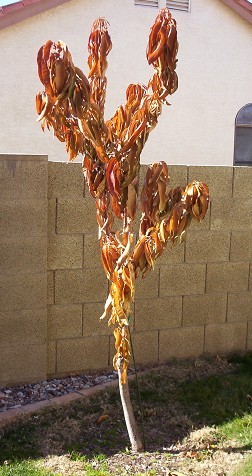
The photo on the right shows a 7 foot mango tree two weeks after a killing frost.
It was given minimal protection from the cold, a sheet was wrapped around
its trunk base, and is therefore displaying
pretty brown and gold fall colors which is unusual adornment for a mango tree.
The tree has a 2.5 inch diameter base and is 4 years old, so it is starting
to become fairly large. This mango tree actually survived the frost but
became much shorter, about a foot tall. See below for more details.
Overview
While freezing weather and frost are discouraging for anyone growing subtropical and tropical
plants, they can also provide a valuable learning experience. With a clear understanding of how
tolerant plants are to frost, one can avoid wasting time protecting plants unecessarily
and can also know when to really get serious about helping them make it through the night.
Knowledge also aids a gardner in deciding which plants they will attempt to grow.
Of course, with enough technology and effort any plant can be grown anywhere in the world
but deciding whether it is worth the effort is a personal decision.
Described below is an account of an unusually cold winter night in Phoenix Arizona, followed
by a breakdown of how selected plants handled a hard freeze. Lastly, techniques for
protecting plants from freezing weather are outlined.
A chart showing the damage temperature of my most tender tropical and subtropical plants is a available at the following link.
Frost and Freeze Damage Chart for Subtropical and Tropical Plants
A killing frost visits Phoenix
On the night of Saturday January 13th 2007, the South Western US was visited by
an extremely cold arctic air mass.
In California, a great deal of frost damage was done to the citrus crop.
Here in Phoenix, temperatures were the lowest they had been
in 18 years, and all but the largest and most protected ficus nitida trees, a very common landscape
plant, were killed.
Even oleanders around town were frozen back, which is very unusual.
Unfortunately, the weather forecast was only predicting lows at Sky Harbor Airport in Phoenix of 32 F,
so many people were taking by surprise when the temperatures in the urban areas dropped even lower.
An example of just how cold it was can be shown by reviewing the conditions that night
at my home in Northern Mesa, which is in a well developed part of town.
On the outside edge of a covered patio my thermometer read 28 Fahrenheit at 3AM
and 27 F. at 7AM. This equates to 4 full hours below 28 degrees.
Temperatures out in the yard were most likely even colder.
My bird bath accumulated over an inch of solid ice in it.
Additionally, temperatures out in the open lower desert were reported to be as low as
18 F., and people in central Phoenix kept plumbers busy for weeks afterwards fixing broken
pipes.
Hard Freeze Damage Analysis For Tender Plants As Of May 14th, 2007 (4 months later)
Adenium
A small adenium close to the house and covered with a cardboard box on the two coldest nights was killed all
the way to the ground.
Its frost damage initially appeared to be just on its extremeties, but within 8 weeks it became mushy all the
way to its base.
Avocado, Zutano
No damage at all. It is located on the west side of a cinderblock wall.
Banana, Enano Gigante
All of the larger leaves and stocks were frozen back. Tiny banana shoots growing at the base
were not damaged and continued growing. Amazingly, even the larger stocks which looked
completely dead started putting new leaves out of their centers a month after the frost.
The bananas are planted against the east side of the house.
Bougainvillea, Barbara Karst
All of its leaves were immediately killed by the frost.
At 8 weeks new sprouts appeared close to the base of the plant.
Carissa, Natal Plum
Larger carissas were severally frozen back except for parts of the
bush closest to the ground or wall. Parts of the plant that did not freeze kept their
leaves. At 8 weeks, even carissas that lost all of their leaves started to sprout at
the base.
Cherry Of The Rio Grande
Suffered some superficial damage on the smallest trigs and newest growth but was
generally unaffected.
Citrus
The most sensitive citrus trees, such as lemons and limes had damaged leaves and fruit
on the tops. It took a while for this damage to show, and the overall health of the plants
seems unaffected. All of the other citrus varieties were unaffected.
Fig, Black Mission
The fig tree was already dormant having lost its leaves and had no frost damage.
Ficus Benjamina
This ficus was killed completely in all but the most protected locations. It had been planted
widely in court yards and next to houses all over the valley, but even being right up next
to the house did not save most of them. Ficus Benjamina proved to be even more frost
sensitive than Ficus Nitida.
Ficus Nitida
Small, newly planted ficus trees in the neighborhood lost all of their leaves and
after 8 weeks had not sprouted and appear to have been killed.
The very large ficus trees retained some
foliage in their centers. Some medium sized ficus trees lost all of their leaves
but started sprouting at around 6 weeks.
Proximity to buildings and other heat sources was quite
significant.
Guava, Tropical
The guava trees had superficial leaf damage in a light frost several weeks earlier.
All of the leaves on the guava trees were immediately killed by the hard frost.
8 weeks later, both my pink and white guavas started sprouting new
leaves on the main branches near the trunk. The pink guava started sprouting several days
before the white, and recovered more quickly in the weeks following.
Hibiscus
A small canary hibiscus out in the yard was killed all the way to the ground
but maintained one tiny green leaf at ground level. At 10 weeks after the hard freeze
it started showing vigorous growth.
A larger hibiscus
next to the east side of the house was frozen back, but right at ground level the leaves
survived and continued growing. At 8 weeks, the larger hibiscus showed new growth on
the larger branches even in the sections that had previously appeared completely dead.
Jaboticaba
This tree had already lost all of its leaves before the killing freeze. At
12 weeks its main stem was still green and alive.
Jacaranda
All of the Jacarandas around town lost all of their leaves, but after 3 months
they started pushing out vigorous new growth.
Lantana
All lantanas were completely defoliated, but sprouted new growth after 4 weeks from the
stems closest to the base.
Loquat
No frost damage.
Lychee, Brewster
Damage appeared superficial immediately after the hard frost, but 2 weeks later 50% of its leaves had
dropped while the remaining leaves still looked healthy. After 6 weeks only 2 leaves remained. There
appeared to be buds on the stems but it was difficult to tell for sure. At 8 weeks, new growth appeared
on one of the main branches but was very slow. At 10 weeks vigorous new growth began.
Madagascar Palm
This plant was next to the wall of the house and suffered no frost damage. It was already
completely dormant and leafless before the freeze and sprouted new growth in May as it
usually does.
Mango
My mango trees were completely unaffected by a light frost, at approximately 32 F., several weeks
before the hard freeze, but took the subfreezing temperatures more poorly.
The largest mango, pictured at the top of the page, had only a thin sheet tied around its lower trunk on the two
coldest nights, and was completely defoliated. Interestingly, it took a while for it to show damage and
the leaves looked fairly healthy for almost a week afterwards.
About 2 weeks after the freeze, it had green buds on its main trunk but they later turned brown,
which led me to believe it would not recover.
Also, rotting on the frost damaged branches seems to have started progressing into
healthier tissue, so damaged areas were pruned an inch below the rot. This trimming
seems to have stopped the progression.
At 8 weeks, after 6 weeks of no activity, some green buds formed on the trunk several inches from the ground.
At 10 weeks these buds started to grow vigorously into new branches.
Several very small grafted mango trees I had growing in the ground were killed outright, even though they were covered.
This definitely shows that smaller trees need a source of heat in addition to coverage if temperatures drop below 29 F.
A heat source would obviously help a larger mango to sustain less damage as well.
A mangoes ability to handle cold temperatures seems almost identical
to that of ficus nitida, leading me to believe that very large mango trees in urban areas can easily survive
this weather. Now, imagine if all of those ficus trees around town were mangoes.
It makes me wonder why anyone would want to plant a ficus.
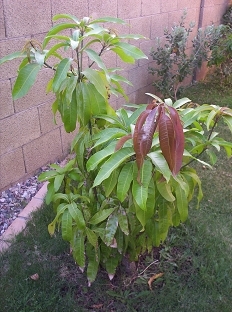
The mango tree with frost damage, shown at the top of the page, is shown in the photo
below 1.5 years after it was damaged.
 Oleander
Suffered frost damage on the edges, which took a long time to show up. Other than that they
are in good shape.
Oleander
Suffered frost damage on the edges, which took a long time to show up. Other than that they
are in good shape.
Orchid Tree, Hong Kong
Lost all of its leaves within days of the hard freeze. At 6 weeks it had both brittle
and more flexible branches, but no new growth. At 8 weeks, strong new growth appeared on
the largest branches.
Papaya
The second most frost sensitive plant I have grown. Solo papayas (Hawaiian) are slightly more sensitive than Maridols (Mexican). The unprotected Solos
had leaf damage even with a light frost, at approximately 32 F., several weeks before the hard freeze, but the
stems were undamaged, and the emerging leaves shadowed by the larger leaves were also undamaged. Light frost did
not affect the Maridols. During the hard freeze, both types of papayas froze solid at around 30 F.
Keeping a papaya alive below the freezing mark definitely requires coverage.
Passion Fruit, Frederick
Lost all of its leaves immediately after the hard freeze, but its main stem close to
the ground remained green. At six weeks some new growth appeared on the main stem
near the base. Growth was slow at first but by 12 weeks became stronger.
Pineapple Guava
No frost damage.
Plumeria
The most frost sensitive plant I have grown.
Unprotected plumerias had minor leaf damage even with a light frost, at approximately
32 F., several weeks before the hard freeze, but the growing tips were undamaged.
The night of the hard freeze, I covered a small plumeria tree with frost cloth.
Later in the night, when the temperature was 29 F., I added a 100 watt light bulb
underneath the cloth. The tree's growing tips ended up being frozen back, but the main
trunk survived.
At 2 weeks, rotting on the frost damaged branches seems to have started progressing into
healthier tissue, so damaged areas were pruned an inch below the rot.
This trimming seems to have stopped that progression.
At 8 weeks, the tree was looking worse than at 6 weeks and sections of the trunk appeared
to be in decline. It definitely would have been better to put the light bulb
in earlier in the night.
At 10 weeks the stem started to bud vigorously even though the trunk is a patchwork of living and dead
tissue and very cracked. This tree is definitely on the mend.
Royal Poinciana
A very large Royal Poinciana in the neighborhood, with a diameter of about 6 inches
at its base, lost of all its leaves.
Amazingly, after 4 months it started sprouting from its main trunk 2 feet above the ground.
Star Fruit
A small seedling star fruit which I had in the ground for years was completely killed. It was always an
extremely slow grower and never flowered. I have since then purchased a grafted star fruit named
Sri Kembangan. It is actually doing quite well and if far more vigorous than the seedling I previously had.
Furthermore, I am growing it next to the house were it will receive more frost protection. I will post an article
on it when it fruits.
Tropical Bird Of Paradise
No damage to the leaves or stems. A flower that was currently open was desiccated.
It is planted next to the north side of the house.
White Sapote
The same white sapote tree that is pictured in the article on this site was left unprotected. It was completely
defoliated by the killing frost, but started to push out new buds 4 weeks later. By 6 weeks it was covered with new
growth, except on the smallest most exterior twigs.
Yellow Oleander
Almost completely defoliated, but survived with only peripheral branch damage. At
4 months most of these plants in the neighborhood have new growth but still look
beat up.
A review of the physics of cold damage to a plant
Plant Hardiness Freezing
Water freezes at 32 degrees Fahrenheit (0 degrees Celsius).
Plant sap contains water and when it freezes and crystalizes it expands breaking and killing the plant cells that contain it.
However, the sap of a plant is not just water, but is
also a mixture of sugars and nutrients and other components which lower its freezing temperature below 32 F. Just how low
temperatures have to go to freeze the sap of a plant is dependant on the type of plant.
Plants that are more cold resistant are refered to as being more hardy.
Tropical plants, being from climates that are warm year round, are the least hardy, but few if any will
be damaged right at 32 degrees, because all plants have some sugar in their sap.
Any article stating that a plant cannot handle temperatures below 50 F. or 40F. is highly likely to be incorrect.
It is possible that certain plants will become sick and eventually die if temperatures are consistently that low,
day and night for weeks, but that is different than saying a plant will be damaged if temperatures drop that low at
night. It is important to make this distinction when researching what will grow where you live.
Plant Hardiness Frost
A plant can still be damaged at 32 F. even if its saps freezing temperature is lower. The reason this can happen
is that frost forming on the the leaves of a plant can pull moisture out of the cells on the leaf surface, which
dehydrates and kills those cells. Frost dehydration damage is typically superficial and only affects parts of the plant
most exposed to the open sky. A plants ability to resist this kind of damage depends on the anatomy of the surface
of its leaves, and once again tropicals are the most sensitive.
Interestingly, frost can actually occur when thermometers read temperatures above freezing. Here
is an article that explains this apparent paradox.
Frost above freezing?
Heat Transfer
Heat flows from objects at higher temperatures to objects at lower temperatures. On a cold night the warmer
objects are the ground, buildings and bodies of water and the colder objects are the air and the night sky.
Warmer objects can be refered to as heat sources and colder objects as heat sinks. Plants are not large enough
to be a heat source or sink so they are caught between the two, and heat will simply flow through them. The
closer a plant is to a heat source the warmer it will be. So, the goal of keeping a plant warm is to actually
have it physically close to a heat source and to insulate it from the heat sink. Insulation slows down the transfer
of heat through the plant and makes its temperature closer to that of the heat source.
Techniques for protecting tropical and subtropical plants from frost and freezing weather
Covering Plants
Unlike people, plants do not have an internal heat source, so they must be covered
in a way that insulates them together with a source of heat. This source is most commonly
the ground. Simply wrapping a plant in a blanket will do little to keep it warm, because
one would just be insulating the plant itself against everything around it. Yes,
the insulation will slow the transfer of heat to the surrounding environment from
the plant itself, but there isn't a whole lot of heat in a plant compared to other sources
like the ground.
Instead, the insulation should be put over the top of the plant and attached to the ground around it,
creating a tent, with the ground as a floor. The less that air can move in and out of
this tent the better.
With particularly tender plants, an additional heat source can be added to the tent.
Incandescent light bulbs give off a significant amount of heat. For safety, use
grounded outdoor cords. For a socket, the light bulb cages that come with a hook
and extension cord, for hanging under the hood of a car while working on it, are a good
choice. The old style outdoor Christmas light strings, that have hot incandescent bulbs,
are also a good choice because they will distribute the heat over a larger area.
One will also have to decide what to use for insulation. A bed sheet is a good start
but a more insulating fabric will provide more protection. However, a very heavy
blanket can create problems because the weight of it can break limbs, and it can be hard
to keep on top of the plant.
Also, an ideal cover can be left on the plant during the day, in the case that
temperatures are going to drop down at night for several days in a row, which is
usually the case. Frost cloth is a special fabric made to address all of these problems.
It is light yet insulating, but it still allows some sunlight to come through during the day.
For smaller plants or large areas one might also consider building a structure over
the plant on which to mount the cloth. Using 1.5 inch pvc pipe is an inexpensive and
easy way to create a temporary scaffold.
Having a structure to hold up the fabric also
helps the plant to sustain less damage because leaves and branches that come into contact
with the covering will be damaged as if they were unprotected. This damage occurs
because contact with the fabric allows heat to be more easily transfered through these points.
Watering Plants Water is a substance with a high heat capacity, meaning
it stores a relatively large amount of heat compared to other substances at a given
temperature. For this reason, it is a good idea to water ones plants the day before
an especially chilly night. Not only will the plant have a little bit more heat stored
for the cold night, but more significantly the ground around it will be wet and store
more heat as well. It is not a good idea to this night after night because if the ground
is kept too wet it can cause a plants roots to rot.
Spraying Plants With Water All Night When a glass of water is being frozen
it will stay at 32 degrees Fahrenheit until all the water in the glass is solidified.
This is an interesting concept from Physics called a phase change. Since most plants
actually freeze below 32 degrees, they can be saved from freeze damage by keeping their
temperature at waters freezing point. Spraying water on a plant when temperatures are
below freezing will keep the plants temperature at 32, because the warmer liquid water
is constantly being supplied. Another way to think of it is that the process of freezing
water requires the colder surrounding air to suck heat out of the water.
So, constantly supplying liquid water means constantly supplying heat. The downsides
of this method are that ice will build up and its weight can crush the plant, one
could waste a lot of water, it can create a muddy mess, and all of that soaking
might not be good for the plants roots.
Microclimate Planting frost sensitive plants near heart sources to begin with can
go a long way in protecting them. Significant sources of heat are buildings,
concrete walls, and bodies of water. Well developed neighborhoods will always be
warmer at night than outside of town. The eave of a house reduces heat loss
from the space below it to the sky.
Links to more frost damage information
Frost and Freeze Damage Chart for Subtropical and Tropical Plants
University of Arizona - Frost Protection
echo-compendium-of-warm-climate-fruits.pdf
This pdf is copied from https://www.echocommunity.org/
|
 Join The Phoenix Tropicals Gardening Forum On Facebook
 Book the Phoenix Tropicals Condo on Kiahuna Beach, in Kauai, Hawaii