|
 Photo
Photo
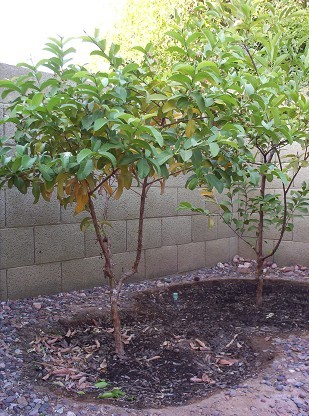
The two trees pictured on the right are tropical guavas. The closer one is a pink
and the further one is a white, most likely a Turnbull. They were planted approximately two years before
this picture was taken and have tripled in size since planting. Both plants started
producing a small amount of fruit immediately but didn't become really productive
until they reached a year old. The taste of the fruit improved over time as well.
Being located in the North East corner of the yard
they receive a fair amount of afternoon sun before being shaded by the house after
five in the evening. Being close to the walls also helps to protect them from
freezing in the winter.
Overview
Tropical guavas are one of the easiest to grow of all the tropical fruits.
Once established, they do
very well in the summer heat. There are hundreds if not thousands
of varieties of tropical guavas. Most often people just refer to tropical guavas by
the internal color of their fruit, although some select cultivars have been isolated.
It is important to distinguish between
tropical guavas, cattley guavas, and pineapple guavas (feijoas).
Cattley guavas do not do very well in Phoenix because they struggle in our hot summers
and alkaline soil. With a lot of effort a cattley guava can be kept alive but
will still most likely end up producing sour fruit. Cattley guavas can be distinguished
from tropical guavas because they have smaller thicker shinier
leaves and small fruit. They come in two cultivars named Strawberry Guavas and Lemon Guavas.
Cattleys are more hardy than tropical guavas so they might actually be a good fit for
elevations of 2000 to 4000 feet in Arizona where summers are cooler but winters are not
ever colder than 20 degrees. Southern California is an almost ideal climate for them.
More information on cattley guavas can be found on
Julia Morton's site.
Feijoas (Pineapple Guavas) grow fairly well in the lower desert but can take years to
fruit especially if they are seedlings. They do best on a grass watering schedule
with afternoon shade. To minimize the time it takes them to fruit, buy two grafted varieties that will cross pollinate
and also cross pollinate them by hand. Never fertilize pineapple guava trees in our soil, because they burn very easily
and grow well without any fertilizer. I have included a posting in the forum showing my
pineapple guava flowers
and
pineapple guava fruit.
More information on feijoas can be found at
Julia Morton's site and
on the
CRFG site.
 Fruit
Fruit
Tropical guava varieties are available as seedlings, grafts, and rarely as air layers.
Many seedlings are close to if not the same quality as their parents,
and have the advantage of always recovering from a freeze true to type,
even if frozen all the way to the ground.
Grafted guavas are especially high quality varieties, but the graft can
potentially be lost with an especially hard freeze.
Air layers are genetically identical to their parents and will also
recover true to type from a hard freeze, so they are best of all.
Tropical guava fruit quality in the lower desert can be excellent.
Guavas in Phoenix flower twice a year,
in the spring and
fall. The flowers are white with many stamens and have a mildly
sweet scent.
The spring flowers become ripe in late summer while the fall flowers
become ripe in late spring.
All guavas have an unusual aromatic floral flavor not found in other fruits.
Below I have detailed the characteristics of the guavas I currently have growing
in my yard.
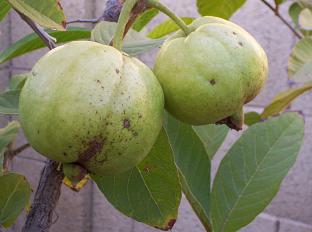
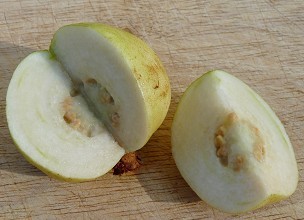
S.E. Asian White guava fruit, shown above hanging on the tree and below on the right,
are crunchy and round, and pear like in texture
and even in flavor. The seeds are generally hard in this variety and just barely chewable, but
I generally eat around the seed core.
My white guava tree was named "Bangkok Apple" by the seller I bought it from, and was grown from seed.
It is most likely a variety known as "Turnbull".
The skin of its fruit and its leaves have a cinnamon quality to them. There is another variety of
white guava which is soft, pear shaped, with chewable seeds, and more similar to the tropic pink variety,
because it has more of the guava aroma to it. I am working on getting one of these trees as well, because it is
definitely delicious in its own way.
 My white guava tree froze all the way to the ground on a phenomenally cold night in January
of 2007. It has since recovered from its roots and produced fruit equal to its fruit before it was frozen.
On the same night, my pink tropical guava only froze about half way to the ground, leaving me to believe
that white guavas are more cold sensitive than pink.
My white guava tree froze all the way to the ground on a phenomenally cold night in January
of 2007. It has since recovered from its roots and produced fruit equal to its fruit before it was frozen.
On the same night, my pink tropical guava only froze about half way to the ground, leaving me to believe
that white guavas are more cold sensitive than pink.
The fruit on this tree ripens in late spring and early fall. The flavor of the fruit
is best when daytime high temperatures are below 100 F.,
so about half of the crop is of peak quality in the fall and the majority of the crop is at peak quality in the spring.
It is difficult to tell when
a white guava is ripe by color. When close to ripe it starts to get some yellow on its
skin but it can be in this state for quite some time before it is actually
ready to eat.
The best way to tell if a white guava is ripe is to smell the flower
end. If it smells sweet then the guava is ready. Sometimes the flower
end of the guava will also get soft, but if one waits for this indicator
then it is more likely the guava will be overripe.
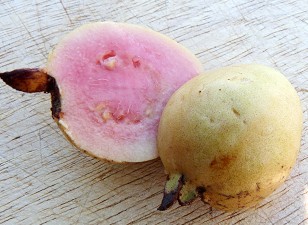
Pink guava fruit are softer than S.E. Asian white, have chewable seeds, and turn a bright yellow
when they are ripe. They have a stronger smell and flavor
which makes them great for juice and jam.
My pink guava tree was named "Tropical Pink" by the seller I bought it from, and was grown from seed.
 My pink guava tree froze half way to the ground on a phenomenally cold night in January
of 2007. It has since recovered and produced fruit equal to its fruit before it was frozen.
On the same night, my white tropical guava tree froze all the way to the ground, leaving me to believe
that pink guavas are more hardy than the white.
My pink guava tree froze half way to the ground on a phenomenally cold night in January
of 2007. It has since recovered and produced fruit equal to its fruit before it was frozen.
On the same night, my white tropical guava tree froze all the way to the ground, leaving me to believe
that pink guavas are more hardy than the white.
The fruit on this tree ripens in late spring and early fall. The flavor of the fruit
is best for straight eating when daytime high
temperatures are below 100 F., so about half of the crop is
of peak quality in the fall and the majority of the crop is at peak quality in the spring.
When temperatures are high the fruit flavor is very strong and musky and not very sweet but
it is still very good for juice and smoothies.
When ripe a pink guava will fall off the tree. However, it is better
to pick them right before they get to the falling point so that they are
not overripe. To check if they are ready, cradle them in your palm and
tap them with your fingers. If they fall off in your hand, then they are perfect.
Mexican Cream is a grafted variety tropical guava I am growing. It is a yellow guava with a
yellow interior. It is very delicious regardless of high summer temperatures, so
I currently rank it as my favorite. Like the other tropical guavas listed on this page it
fruits in the spring and fall. When ripe, the fruits become very loosely held on the tree
and often fall off similar to the pink guava. If you want to know what a Mexican Cream
tastes like, it is the variety of guava used in Jumex canned guava juice.
I planted this tree after the freeze of 2007 so I have yet to see how it handles
freezing temperatures. Since it is a graft, I cover it on the coldest
winter nights.
Heat Tolerance and Sun Exposure
Tropical guavas do very well in the summer in Phoenix. In fact, the higher
the temperature gets the more rapidly they grow. However, newly
planted guavas should be protected from afternoon sun their first summer.
Cold Tolerance
Guavas are hardy down to 29 degrees Fahrenheit so it is best to plant them
close to houses, walls or other objects that store heat at night. When
planted in a good microclimate within the city, there is little reason to be
concerned about a guava during the winter. People living near the outskirts of
town might want to cover their plants during unusually cold winter nights.
Fortunately, if frozen to the ground guavas will usually re-emerge from their
roots the next spring.
In cool weather, guavas will develop a purple discoloration on their leaves.
This is not frost damage and happens every winter without damaging the plant.
Planting
Dig a hole at least twice the size of the rootball. At a minimum, make the
hole 2 feet in diameter and 2 feet deep.
Back fill the whole with the same native soil that was removed.
It also is a good idea to finish with the
hole an inch or two recessed so that a watering basin is formed.
After planting, spread a thin layer of compost on top
of the soil to help conserve moisture and to supply some nutrients.
Do not fertilize the newly planted tree until it has been vigorously growing for
a couple of months.
Watering frequency
Guavas do well on a grass watering schedule.
Watering method
Basin or flood irrigation
is recommended because it helps keep the salt in our salty
water from accumulating around the roots. Furthermore, deep watering
will encourage the plant to develop deeper roots, making the plant tougher when the weather
gets hot and dry.
Fertilizing and Growth Rate
Guavas grow rapidly and are therefore heavy feeders.
During the growing season, approximately April to October, a guava can be fertilized every 2 to 4 weeks
using a high nitrogen fertilizer. They should not be fertilized during the cool time
of the year when they are growing slowly. I have found the fertilizers with a 5 to 1 nitrogen to phosphorus and
potassium ratio work best, such as fish emulsion 5-1-1, and Miracle Grow 36-6-6.
Bloom booster type fertilizers with high phosphorus and potassium ratio do not appear to promote
blooming as one would hope, and instead seem to burn guavas.
Propagation
Guavas are somewhat true from seed, meaning that the plant from a seed
will be similar to its parent. Still, the best varieties of guava are grafts, air layers,
or root cuttings. Air layers and root cuttings are more desirable for the Phoenix
area than grafts because the home grower will have no worries about the plant
freezing down to the graft level.
Pests
S.E. Asian White guavas have a problem with little flying beetles in the fall. These beetles
will start eating the flower end of the guava right before it gets ripe. Sometimes
the ruined section of guava can be cut away and the rest is salvageable.
Fortunately, the spring crop of guavas is not bothered by them.
Links to more tropical guava information
Julia Morton
California Rare Fruit Growers
|
 Join The Phoenix Tropicals Gardening Forum On Facebook
 Book the Phoenix Tropicals Condo on Kiahuna Beach, in Kauai, Hawaii